Agentic AI in 2026-2027: How Autonomous Agents Will Transform Your Business (Before Your Competitors)
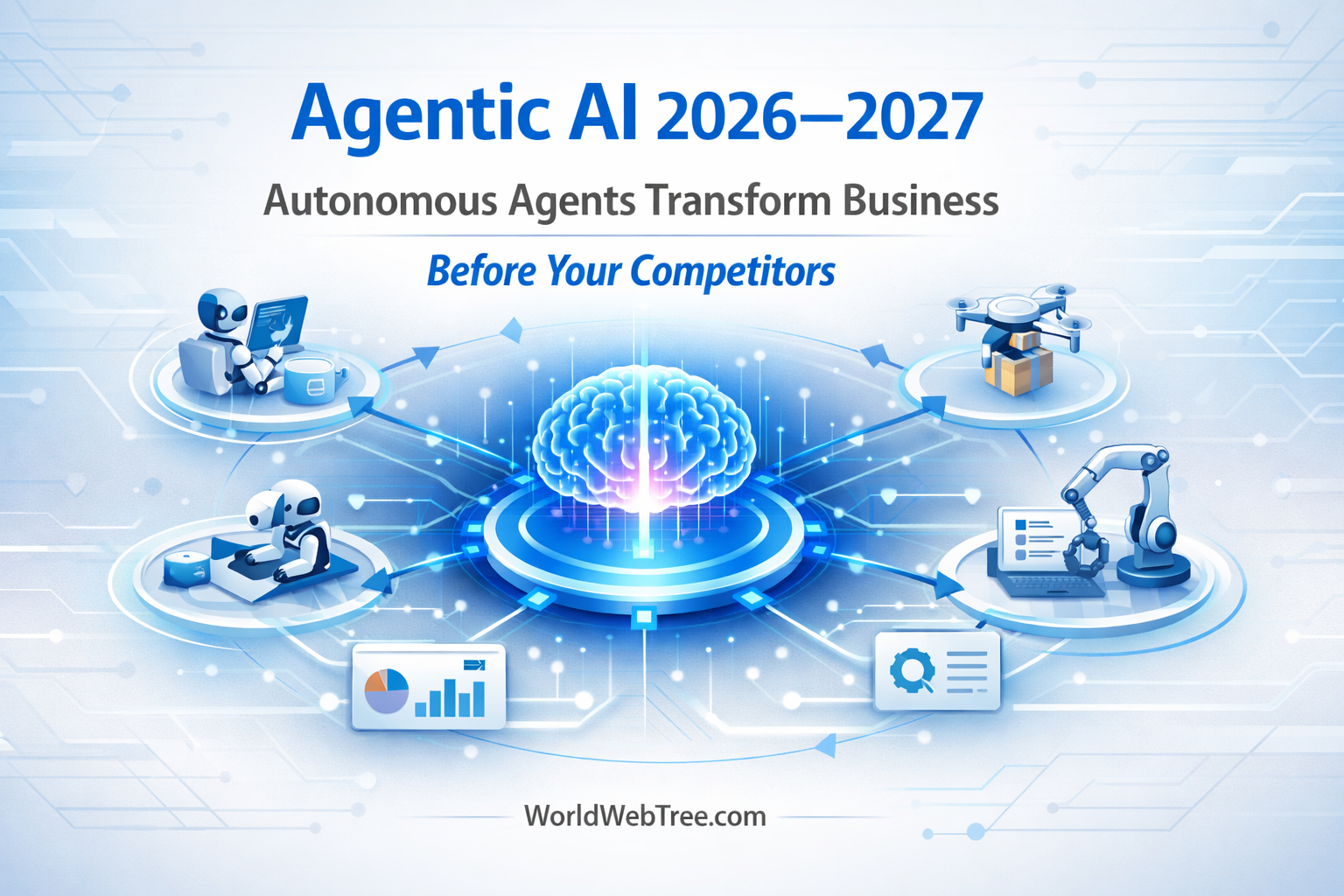
Agentic AI in 2026-2027: How Autonomous Agents Will Transform Your Business (Before Your Competitors)
Summary: Discover how agentic AI and autonomous agents are reshaping business in 2026-2027. Learn what agentic AI actually is, real-world use cases, and how startups can implement autonomous agents to 10x productivity and compete with enterprises.
The Seismic Shift: From ChatGPT to Autonomous Agents
In 2023-2024, the narrative was clear: AI chatbots. ChatGPT changed everything. Enterprises and startups raced to integrate conversational AI into their products.
But something fundamental is shifting in 2026. The future isn't AI that talks to you. It's AI that works for you. AI that makes decisions, takes actions, solves problems autonomously. Welcome to the era of agentic AI.
This isn't science fiction. Autonomous agents are already operating in production across finance, healthcare, and e-commerce. Companies using agentic AI are reporting 10-15x productivity gains. Their competitors? Still training employees to manually handle tasks that autonomous agents now execute in seconds.
The gap is widening. And 2026-2027 is when it becomes impossible to ignore.
What is Agentic AI? (And Why It's Different From ChatGPT)
Let's be precise, because there's a lot of hype masquerading as agentic AI.
Traditional AI (ChatGPT, Claude, etc.): You ask a question. The model responds with text. You decide what to do next. The AI is reactive, not autonomous.
Agentic AI: You give the agent a goal. The agent breaks it down into steps. It uses tools (APIs, databases, external services) to execute those steps. It monitors results. It adjusts strategy if something fails. It works until the goal is achieved. All without asking for permission.
The key difference: agency. The ability to act independently, use judgment, and persist toward a goal.
Here's a concrete example:
ChatGPT approach: "Write me a customer support response." You copy the text. You paste it into your email. You hit send. 2 minutes of human time.
Agentic AI approach: Agent receives support ticket → analyzes customer issue → searches knowledge base → queries order history → checks inventory → drafts response → routes to approval if needed → sends email → logs ticket as resolved. 0 seconds of human time. Agent handles 50 tickets while your team handles 5.
This is the revolution.
The Agentic AI Stack: Tools & Frameworks in 2026
Building autonomous agents requires more than just a language model. You need:
1. The Brain (LLM)
Claude (Anthropic), GPT-4 (OpenAI), and Gemini (Google) are the primary brains powering agents. Claude leads in reasoning and following complex instructions without hallucinating.
2. The Orchestrator (Agentic Framework)
LangChain — Chains together multiple AI calls and tool use. Most popular framework for agentic workflows.
AutoGPT — Open-source agent framework. Self-improving and autonomous.
n8n — No-code/low-code workflow automation. Perfect for non-technical teams building agents.
CrewAI — Multi-agent framework. Orchestrates teams of specialized agents working together.
3. The Tools (What Agents Use to Act)
Agents need access to external tools to be useful. APIs for:
- Stripe (payments)
- Salesforce (CRM)
- Intercom (customer data)
- Slack (messaging)
- Twilio (SMS/calls)
- Google Sheets (data)
- Your own proprietary APIs
4. The Memory (Persistence & Learning)
Pinecone — Vector database for agent memory and context retrieval.
Supabase — PostgreSQL database to store agent decisions and results.
Real-World Agentic AI Use Cases in 2026
1. Customer Support Agents
Agent reads incoming ticket → queries knowledge base + CRM → checks order/billing history → resolves 80% of tickets autonomously → escalates 20% to humans with full context.
Impact: Support costs drop 70%. Response time drops from hours to seconds. Customer satisfaction up 40%.
Companies like Zendesk are integrating agentic AI into their platform. By 2026, this is table stakes.
2. Sales/Lead Qualification Agents
Agent receives inbound leads → researches company + decision maker → pulls historical interactions → assesses fit → scores lead → sends personalized outreach → books meeting if qualified.
Impact: Sales reps focus on closing deals, not qualification. Lead response time: 5 minutes. Conversion rate up 35%.
3. Financial Operations Agents
Agent receives invoice → matches to PO → validates against contract terms → checks budget availability → processes payment → logs in accounting system → sends confirmation.
Impact: Invoice-to-payment cycle drops from 5 days to 5 minutes. Working capital improves. Finance team focuses on strategy.
4. Data Analysis & Insight Agents
Agent gets query: "What's our customer churn trend by cohort?" → accesses data warehouse → runs SQL → creates visualizations → flags anomalies → generates insights → publishes report.
Impact: Analytics questions answered in minutes instead of days. Business moves faster.
5. Code Generation & DevOps Agents
Agent receives feature request → designs architecture → generates code → writes tests → deploys to staging → runs validation tests → creates PR with comments.
Impact: Developers review and merge instead of building from scratch. Development velocity 3x faster.
Why 2026-2027 is the Inflection Point
1. LLMs Are Reliable Enough
In 2024, LLM hallucinations were a blocker. By 2026, newer models (Claude 3.x, GPT-5 rumors) are more reliable. Agents can now run unsupervised without constant failure.
2. Enterprise Adoption is Accelerating
Major players are building agent capabilities:
- Google Cloud launched Agent Builder (agent creation for enterprises)
- Microsoft Azure integrated agents into Copilot ecosystem
- AWS Bedrock added agent capabilities
When enterprises move, everyone follows.
3. Cost is Dropping
API costs for LLMs have fallen 90% since 2023. Running an autonomous agent on Claude costs $0.02-0.10 per task. Even startups can afford 1M agent runs per month for <$5K.
4. Open-Source Tooling Matured
LangChain, CrewAI, and others are production-ready. You don't need to build from scratch anymore.
How Startups Can Implement Agentic AI Today
Phase 1: Identify Your First Agent (Week 1)
What's a repetitive task your team hates? Something that:
- Takes 30+ minutes per occurrence
- Happens daily or weekly
- Requires accessing multiple data sources
- Doesn't need human judgment (or judgment is 95% predictable)
Examples: lead qualification, invoice processing, customer support triage, data entry, report generation.
Phase 2: Build MVP Agent (Weeks 2-4)
Use n8n or CrewAI to prototype. You don't need a full engineering team.
- Define agent goal
- Connect tools/APIs it needs
- Set up monitoring (does it work?)
- Test with 10 real tasks
Phase 3: Measure Impact (Week 5+)
- Time saved per task?
- Error rate vs human?
- Cost per task?
- Customer satisfaction?
If metrics are positive, expand. Scale to more tasks.
Cost to build agent MVP: $500-2,000 in API costs + 1-2 weeks engineering time.
Common Mistakes When Building Agents
Mistake 1: Expecting Perfect Autonomy
Agents aren't perfect. They need guardrails. Always have a human review high-stakes decisions (payments, legal, customer escalations). The goal isn't zero human involvement—it's smart human-AI partnership.
Mistake 2: Giving Agents Too Much Access
An agent that can access your entire database and execute any API call is a liability. Scope carefully. Give agents the minimum access needed.
Mistake 3: Not Monitoring Agent Behavior
Deploy an agent and forget about it? Recipe for disaster. Log every action. Alert on anomalies. Review decisions regularly.
Mistake 4: Ignoring Failure Modes
What happens if the API is down? If the database is slow? If the agent encounters data it's never seen? Build failure handlers and human escalation paths.
Mistake 5: Building Custom When COTS Exists
Don't build your own agentic framework. Use LangChain, n8n, or CrewAI. They've solved 80% of the problems already.
The Competitive Advantage Window
Here's the thing: agentic AI is moving fast. Companies adopting in 2026 will have a 12-24 month advantage over competitors who wait until 2027-2028.
If you're running a startup in any knowledge work field—sales, support, operations, analytics, engineering—an autonomous agent could 3-5x your productivity. That's a competitive moat.
The businesses that will dominate 2027-2028 are the ones deploying agents in 2026.
Building Your Agentic AI Strategy
Think about your business:
- What tasks waste the most human time?
- What decisions are predictable?
- Where could you 10x productivity?
- What's the cost of manual execution?
Now imagine an autonomous agent handling all of it. That's your 2026 competitive advantage.
Ready to Build Autonomous Agents?
WorldWebTree specializes in implementing agentic AI solutions for startups and enterprises. Our architects have built production agents for customer support, sales operations, financial processing, and data analytics.
We help you:
- Identify your first high-impact agent
- Design agentic workflows
- Integrate with your existing systems (CRM, databases, APIs)
- Build custom agents using LangChain, CrewAI, or n8n
- Deploy, monitor, and optimize
Our approach: Start with one agent. Measure impact. Scale to your entire operation.
We've worked with fintech startups building agents for invoice processing, SaaS companies automating customer support, and AI-native startups coordinating multi-agent systems.
Book a free consultation to discuss your agentic AI roadmap. We'll map out which agent will drive the highest ROI for your business. No pressure, no fluff.
Or reach out directly with your use case and we'll give you a ballpark estimate.
About the Author
Umar FarooQ is the CEO & Business Specialist at WorldWebTree. With deep expertise in AI systems, full-stack development, and agentic workflows, Umar has architected autonomous agent solutions for 20+ startups and enterprises. His work in AI & Data Solutions focuses on building autonomous systems that multiply team productivity.
Connect with Umar: LinkedIn (Umar-444) | WorldWebTree