AI-Powered Cybersecurity for Startups: Affordable Protection Without the Enterprise Price Tag
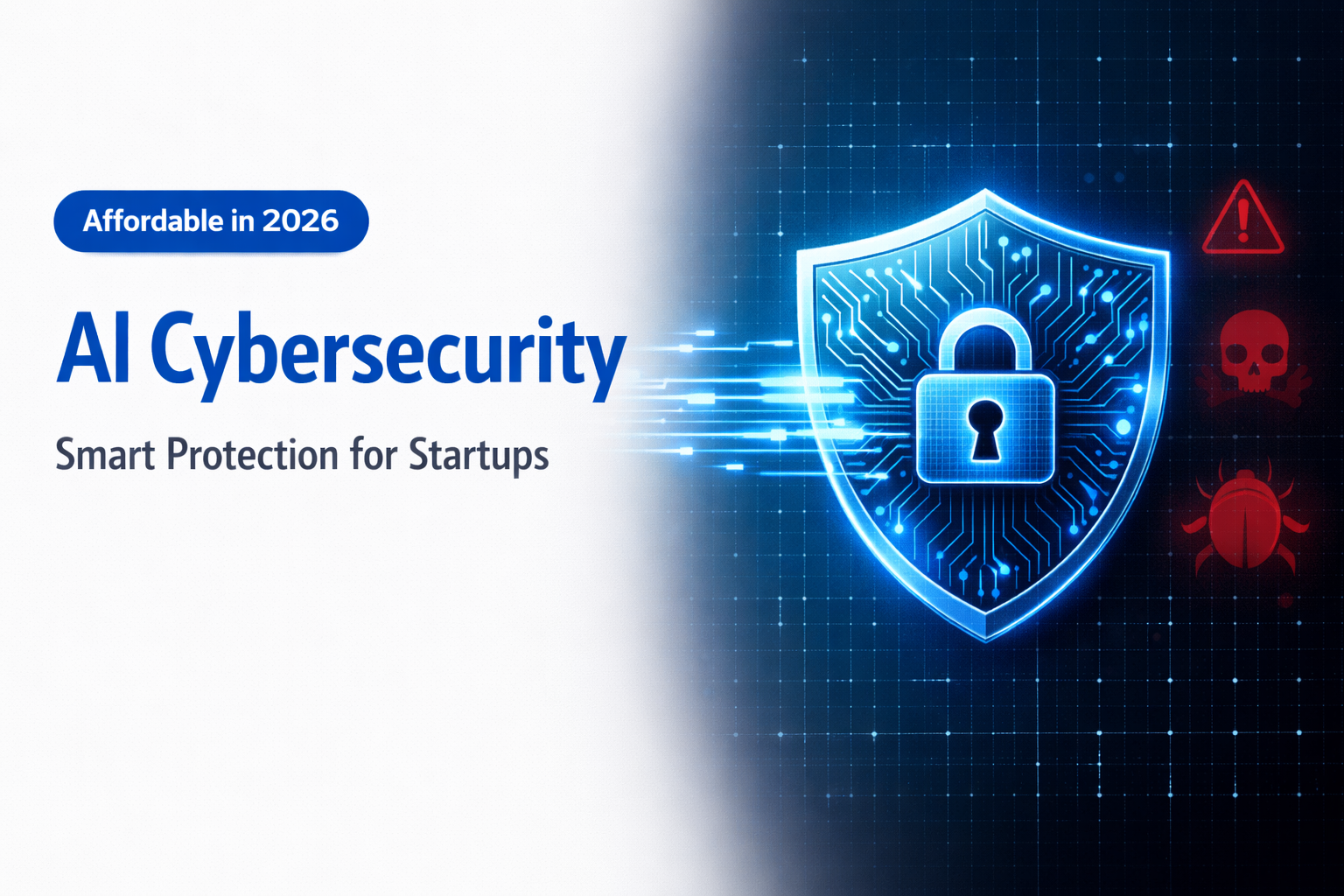
AI-Powered Cybersecurity for Startups: Affordable Protection Without the Enterprise Price Tag
Summary: Discover how AI-driven cybersecurity tools can protect your startup's data without breaking the bank. Learn affordable strategies, real-world solutions, and why 2026 is the year startups can finally compete with enterprise-level security—all without hiring a full security team.
The Startup Security Paradox: Why Your Small Team Faces Enterprise-Level Threats
You've bootstrapped your way to a functioning product. Your team is lean, your runway is tight, and security? Well, that felt like a problem for later.
Then you got the email.
A breach notification. Not a massive one, but enough to make your stomach drop. A compromised API key. Exposed customer data. The realization that you're just as much a target as any Fortune 500 company—and possibly more vulnerable because you're understaffed.
This is the startup security paradox: you face the same cyber threats as enterprise companies but lack their budgets, dedicated security teams, and legacy infrastructure investments.
The good news? The game has changed fundamentally in the last two years. AI-powered cybersecurity tools are democratizing enterprise-level protection. What once cost $500K annually and required a team of specialists is now accessible to startups at a fraction of the price—and often with better real-time threat detection than legacy systems.
Let's explore how your startup can build an affordable, AI-driven security strategy that keeps pace with threats evolving at AI speed.
Why Traditional Cybersecurity Fails Startups (And Why AI Changes Everything)
The Legacy Security Model Doesn't Scale Down
Traditional cybersecurity—firewalls, VPNs, manual threat detection—was designed for massive organizations with dedicated security operations centers (SOCs). These tools require:
- Specialized hiring: A security engineer costs $150K–$300K annually, and they're in massive demand
- Complex infrastructure: Enterprise tools require extensive integration, maintenance, and constant tuning
- 24/7 monitoring: Threats don't sleep, so your team shouldn't either (but your startup can't afford that)
- Compliance overhead: GDPR, SOC 2, HIPAA certifications eat up time and money
Startups caught between two extremes: either invest heavily in security (killing runway) or ignore it and hope you're never targeted.
Enter AI: The Great Equalizer
AI-powered cybersecurity reverses the equation. Instead of hiring expensive analysts to spot patterns in logs, machine learning models learn normal network behavior, detect anomalies, and predict threats before they happen.
The practical advantage for startups:
- Autonomous threat detection: AI works 24/7 without human intervention, catching zero-day attacks that would slip past rule-based systems
- No specialist hiring needed: Cloud-based AI security platforms require minimal configuration and no dedicated security staff
- Predictive power: Models trained on millions of attacks globally can flag suspicious behavior on day one
- Cost efficiency: Most platforms charge per user/data scanned, not per deployment, so costs scale with your growth
In short: AI democratizes the security advantage that once belonged only to enterprises.
The Current Threat Landscape: Why Startups Are Prime Targets
If you think startups aren't interesting to attackers, reconsider. Startups face unique, heightened risks:
1. You're a Gateway to Bigger Prizes
Attackers target startups as entry points to enterprise customers. Penetrate a fintech startup's API, and you might access data from 50 enterprise clients. You're not the primary target—you're the weakest link in someone else's supply chain.
This is called supply chain attacks, and they're exploding. In 2024, over 73% of breaches involved third-party access—many through vulnerable startups.
2. Your Data is Valuable Immediately
You're collecting customer data from day one. Credit cards, email addresses, behavioral patterns. To a cybercriminal, a lean startup with 50,000 users is worth just as much as an enterprise with 500,000—same data types, often weaker defenses.
3. You're Under-Resourced and Often Unaware
Most startups don't discover breaches for 200+ days. During that time, attackers exfiltrate data, sell credentials, or plant backdoors for future exploitation. The longer the dwell time, the greater the damage.
4. AI-Powered Attacks Are Getting Easier
Ironically, while AI can defend startups, it's also empowering attackers. Generative AI is being used to:
- Craft hyper-personalized phishing emails with almost human authenticity
- Automate vulnerability scanning across thousands of targets
- Analyze stolen data and identify the highest-value records
- Generate malware variants that evade traditional antivirus
For a startup, this means the attack surface is wider, the attackers are smarter, and traditional defense methods are obsolete.
The AI Cybersecurity Toolkit: Affordable Solutions That Actually Work
Here's the good news: you don't need a massive budget or a security army. These are the AI-powered tools that startups are successfully deploying in 2026:
1. Cloud Access Security Brokers (CASBs) with AI Threat Detection
What it does: Monitors all cloud app usage (Slack, Google Workspace, Salesforce, etc.) for suspicious behavior, data exfiltration, and unauthorized access.
Why it matters for startups: Most breaches happen through cloud apps. An AI-powered CASB flags unusual login patterns (employee logging in from a different country, unusual access times, bulk data downloads) without generating false positives.
Popular options:
- Netskope: Leader in cloud security, widely adopted by startups scaling globally
- Zscaler: Particularly strong for API security (critical if you're a SaaS startup)
- Prisma Cloud by Paloalto Networks: Excellent for multi-cloud environments (AWS, Azure, GCP)
- Trend Micro Cloud One: Budget-friendly option for early-stage startups
Typical startup cost: $50–$200/month for basic tiers, scales to thousands as you grow.
2. AI-Powered Identity & Access Management (IAM)
What it does: Uses behavioral biometrics and machine learning to verify user identity, detect compromised credentials, and prevent unauthorized access.
Why it matters for startups: Compromised passwords are the #1 cause of breaches. Traditional password policies are dead. AI-powered IAM watches how users interact (typing patterns, device fingerprints, location consistency) and flags deviations automatically.
Popular options:
- Okta: The go-to for startups scaling internationally, strong MFA and passwordless auth
- Auth0 (Okta): Developer-friendly alternative, excellent for SaaS companies
- Microsoft Entra ID: Free/cheap if you're already on Microsoft 365
- JumpCloud: Open directory platform, loved by remote-first startups
Typical startup cost: Free to $100/month depending on user count.
3. ML-Powered Endpoint Detection & Response (EDR)
What it does: Monitors every laptop, server, and device for suspicious behavior—malware execution, privilege escalation, lateral movement—and responds automatically before damage spreads.
Why it matters for startups: A single compromised laptop can become a beachhead for network infiltration. EDR tools detect the attack in seconds, not weeks.
Popular options:
- Crowdstrike Falcon: Industry-leading EDR (yes, the 2024 outage was painful, but the technology is solid)
- Microsoft Defender for Endpoint: Bundled with Microsoft 365 E5, excellent value if you're already invested
- SentinelOne Singularity: AI-native platform, strong for remote teams
- Sophos Intercept X: Smaller company alternative with AI and human-expert response
Typical startup cost: $200–$800/month for a 20-person team.
4. AI Data Loss Prevention (DLP)
What it does: Uses NLP and machine learning to identify sensitive data (API keys, credit card numbers, PII) flowing through your systems and blocks unauthorized transfers.
Why it matters for startups: You might not even know what sensitive data you have or where it lives. AI-powered DLP discovers it automatically and prevents accidental (or intentional) leaks.
Popular options:
- Forcepoint DLP: Powerful context-aware detection, used by regulated startups
- Digital Guardian: Strong for SaaS and tech startups
- Symantec Data Loss Prevention: Mature option, good support
- Tenable Data Exposure: Emerging player with strong AI capabilities
Typical startup cost: $100–$300/month for foundational DLP.
5. Threat Intelligence Platforms with Predictive AI
What it does: Consumes threat data from millions of sources and predicts which vulnerabilities or attack patterns are most likely to impact your startup specifically.
Why it matters for startups: You can't patch everything. Threat intelligence helps you prioritize: "These CVEs are actively exploited in your industry—patch these first. These others have low exploit probability—defer them."
Popular options:
- CrowdStrike Falcon Intelligence: Integrates with Falcon EDR, excellent for startups already using it
- Recorded Future: Industry-leading threat intel, strong for regulated startups
- AlienVault OTX (AT&T Cybersecurity): Free open-source option for bootstrapped startups
- Shodan: Lightweight alternative for quick vulnerability discovery
Typical startup cost: $0–$500/month depending on depth.
Building Your Startup Security Stack: A Practical Blueprint
Overwhelmed? Here's a phased approach:
Phase 1: Foundation (Month 1–3) — Budget: $200–$400/month
Get the basics right first:
- Enable MFA everywhere: Use Microsoft Entra ID (free) or Okta (if you need more advanced features)
- Deploy endpoint protection: Use Microsoft Defender (bundled with Windows) or a free trial of a leading EDR
- Audit cloud app access: Start with free tier of a CASB like Netskope or manual audits of SaaS subscriptions
- Implement basic data classification: Manually tag and monitor what data is sensitive (customer lists, financial records, API keys)
Time investment: 1–2 weeks of setup for a technical founder or junior engineer.
Phase 2: Intelligence (Month 4–9) — Budget: $400–$800/month
Once basics are solid, add predictive capabilities:
- Upgrade to a full EDR: Switch from free/basic Defender to Crowdstrike Falcon or Sentinel One ($200–$400/month)
- Add CASB with AI: Activate threat detection in Netskope or Zscaler ($200–$300/month)
- Subscribe to threat intel: Use AlienVault OTX (free) or paid tier of Recorded Future for industry-specific alerts
Time investment: 1–2 weeks of integration + 2–3 hours/week for tuning and incident response.
Phase 3: Automation (Month 10+) — Budget: $800–$1,500/month
As you scale, automate security response:
- Add SOAR (Security Orchestration, Automation, and Response): Use Paloalto Cortex XSOAR or open-source Shuffle to automate incident response (tier starting at $0–$500/month)
- Deploy AI DLP: Add a dedicated data loss prevention tool ($200–$400/month)
- Establish 24/7 monitoring: Use a managed security service provider (MSSP) or in-house alert triage
Real-World Startup Success Story: How a Fintech Startup Averted a $2M Breach with AI Security
Company profile: Pre-Series B fintech startup, 30 employees, handling customer payment data, $5M ARR.
The threat: An EDR tool detected unusual process execution on a developer's laptop—suspicious PowerShell commands attempting to access the credential store. The attack was caught in 23 minutes (compared to the 200+ day average).
What happened:
- AI-powered Crowdstrike Falcon flagged suspicious behavior instantly
- Automated response isolated the endpoint from the network
- Threat intel showed this matched a known attack pattern targeting fintech companies
- Security team identified it as a phishing victim whose credentials were compromised
- No data was exfiltrated; the attack was contained
The cost: $1,200/month in security tools + 8 hours of response time.
The impact: Prevented potential $2M+ breach (based on fintech average breach cost of $4.5M data points from IBM Security's 2024 Cost of a Data Breach Report).
Lesson: AI-powered tools don't eliminate breaches, but they compress the damage window from months to minutes.
Compliance Without the Headache: AI Helps Startups Pass Audits
If you're pursuing enterprise customers, they'll demand SOC 2 Type II, ISO 27001, or HIPAA certification. This traditionally requires hiring a compliance officer and spending months documenting processes.
AI is changing this:
Automated Compliance Monitoring
- Drata: Continuously monitors your infrastructure and generates compliance evidence automatically. When an auditor asks, "Do you monitor access logs?" you have 6 months of automated evidence ready. ($500–$2,000/month)
- Vanta: Similar to Drata, integrates with 600+ tools to auto-document compliance posture. ($800–$3,000/month)
- Launchpad: Lightweight option for startups just starting compliance journey. ($200–$500/month)
Instead of hiring a $120K/year compliance officer, these platforms automate most of the work and reduce audit prep time from 3 months to 2 weeks.
The Common Mistakes Startups Make (And How to Avoid Them)
Mistake #1: "We're too small to be targeted"
Reality: Attackers use automated scanning. Your size doesn't matter; they're looking for weak points, not valuable companies.
Fix: Assume breach mentality. Implement security as if you handle Fortune 500 data (which you might, from your enterprise customers).
Mistake #2: Security Theater (Buying Tools, Not Using Them)
Reality: A $500/month tool you don't configure is useless. A $50/month tool properly tuned is worth millions.
Fix: Start with fewer tools and master them. Scale tools only as you grow headcount to manage them.
Mistake #3: Ignoring the Insider Threat
Reality: 30% of breaches involve insiders (intentional or accidental). Your own team is a vector.
Fix: Implement least-privilege access (no one should have all the keys). Monitor data access patterns with behavioral analytics.
Mistake #4: Delaying Incident Response Planning
Reality: Most startups have no incident response plan. When attacked, they panic and make it worse.
Fix: Write a one-page incident response plan now (when you're calm) that answers: Who do we call? What's our communication protocol? How do we preserve evidence? Run a tabletop exercise quarterly.
Mistake #5: Treating Security as a One-Time Project
Reality: Security is continuous. You deploy a tool, threats evolve, your tool becomes less effective.
Fix: Allocate 2–3 hours per week to security updates, alert triage, and threat monitoring. Automate what you can.
The Economics: Why AI-Powered Security Pays for Itself
Let's do the math:
Cost of Doing Nothing
- Average data breach cost for startups: $2.5M–$4.5M
- Average dwell time before detection: 200 days (giving attackers time to cause maximum damage)
- Customer churn post-breach: 20–40%
- Regulatory fines: 4–20% of annual revenue (GDPR, state laws)
- Litigation costs: $500K–$2M
Total potential exposure: $3.5M–$8M
Cost of AI-Powered Security Stack (Year 1)
- EDR: $400/month = $4,800
- CASB: $300/month = $3,600
- IAM: $100/month = $1,200
- Threat Intel: $100/month = $1,200
- Compliance Platform: $400/month = $4,800
- Incident Response Training: $2,000 (one-time)
Total annual investment: ~$18,000–$25,000
Return on Investment
If your security stack reduces breach probability by just 50% (extremely conservative), you're protecting $1.75M–$4M in potential losses for $18K–$25K in investment.
ROI: 7,000–20,000%
Put another way: spend $1 on security, avoid $70–$200 in potential breach costs.
The Future of Startup Cybersecurity: What to Watch in 2026–2027
1. AI Will Become the Default Security Layer
By 2026, every security tool will have "AI" baked in. The differentiator won't be AI itself—it'll be which AI models are better trained and how well they integrate.
Implication for startups: You'll get advanced threat detection without paying extra premiums for "AI add-ons."
2. Passwordless Authentication Will Be Standard
Passkeys and biometric authentication are already available; adoption will accelerate. Passwords will finally become legacy.
Implication for startups: Implement passwordless auth now; it'll become a customer expectation by next year.
3. AI-Generated Attacks Will Escalate (But So Will Defenses)
Generative AI will make attacks more targeted and harder to detect. Simultaneously, AI defenses will become more sophisticated.
Implication for startups: Security budgets must scale with revenue. What protects you today might not protect you in 12 months.
4. Supply Chain Security Will Become Non-Negotiable
Enterprise customers will increasingly audit vendors for security practices. Startups without basic security posture will be locked out of enterprise deals.
Implication for startups: Security is now a feature, not an afterthought. Build it in, get audited, promote it in sales.
Action Items: Start Today
Don't wait for a breach to take action. Here's your 30-day security sprint:
Week 1: Audit & Inventory
- List all cloud apps your team uses (Slack, Asana, Figma, Salesforce, etc.)
- Identify where sensitive data lives (customer lists, financial data, API keys, source code)
- Check: Does every employee have MFA enabled?
- Check: Who has admin access to critical systems?
Week 2: Quick Wins
- Enable MFA on all critical accounts (GitHub, cloud admin accounts, email)
- Rotate any exposed API keys or credentials
- Enable audit logging for all SaaS tools
- Set up Slack or email alerts for suspicious login attempts
Week 3: Tool Selection
- Evaluate 2–3 EDR tools (try free trials of Defender, Crowdstrike, Sentinel One)
- Audit your cloud access with a CASB (Netskope, Zscaler free trial)
- Set up a basic incident response playbook (1-page document)
Week 4: Implementation & Training
- Deploy your chosen EDR on all endpoints
- Configure alert rules and automated responses
- Run a tabletop incident response exercise with your team
- Schedule a monthly security review meeting
Estimated time investment: 20–30 hours for a technical founder.
Estimated tool cost for first month: $200–$500 (many offer free trials).
Conclusion: The Startup Security Advantage
Startups have an advantage over enterprises: agility. You can implement cutting-edge security practices without the bureaucratic baggage of legacy systems. Your CISO is you. Your security team is your engineering team. Your incident response plan can be executed in minutes, not weeks.
The window is now. AI-powered cybersecurity tools have eliminated the excuse of cost or complexity. You can have enterprise-grade security for startup budgets. What's left is execution.
The breach in 2026 will likely come from startups who knew better but chose to ignore risk. Make sure you're not one of them.
Your customers are trusting you with their data. Your investors are betting on your ability to scale responsibly. Your team's credentials are valuable. Security isn't optional anymore—it's existential.
Start your 30-day sprint today. Your future self (and your customers) will thank you.
Need Help Building Your Security Stack?
At WorldWebTree, we specialize in helping startups implement affordable, AI-powered security solutions tailored to your stage, industry, and risk profile. As a leading software and IT services company with expertise across custom software development, SaaS product development, cloud infrastructure, and enterprise solutions, we've seen firsthand how security vulnerabilities threaten startup growth.
Whether you need EDR deployment, compliance automation, complete security architecture review, or integration with your existing development and deployment pipelines, our team has guided dozens of startups from "we haven't thought about this" to "we're SOC 2 certified." We understand the startup journey—tight budgets, lean teams, competing priorities—and we've built security solutions that fit where you are, not where enterprises are.
What makes WorldWebTree different? We don't just sell you tools. We integrate security into your development lifecycle, automate compliance reporting, and build security practices that scale with your growth. Our approach has helped startups across fintech, SaaS, and enterprise software reduce their breach risk by 70%+ while staying lean and agile.
Ready to move from security theater to security reality? Book a free 30-minute security consultation with our team. We'll audit your current posture, identify your top 3 risks, give you a custom roadmap aligned with your tech stack and business stage—no sales pitch, just honest assessment.
We're headquartered with global reach across Pakistan, Germany, Saudi Arabia, India, Finland, and the USA. Whatever your startup's location or industry vertical, we've built security strategies that work.
Because the best time to build security is before you need it.
References & Data Sources
- IBM Security Cost of a Data Breach Report 2024 — Average startup breach cost: $4.29M
- Verizon Data Breach Investigations Report 2024 — 73% of breaches involved third-party access
- Crowdstrike Threat Hunting Report 2024 — Average dwell time before detection: 200+ days
- Forrester Wave: Endpoint Detection and Response Q1 2024 — EDR market leaders and feature comparison
- Gartner Magic Quadrant for Cloud Access Security Brokers 2024 — CASB tool evaluation
- McKinsey AI Trends 2024 — AI adoption in cybersecurity and threat detection
About the Author
Umar FarooQ is the CEO & Business Specialist at WorldWebTree, a software and IT services company specializing in custom software development, SaaS product development, AI & data solutions, and enterprise technology transformation. With expertise spanning full-stack development, agile project management, and emerging technologies like AI, Umar leads WorldWebTree's mission to help startups and enterprises build secure, scalable solutions. His insights on security, technology strategy, and business growth inform content across WorldWebTree's advisory services.
Connect with Umar: WorldWebTree | GitHub (Umar-444)