Low-Code/No-Code Platforms in 2026: How Citizen Developers Are Building Apps 90% Faster (And What It Means for Your Business)
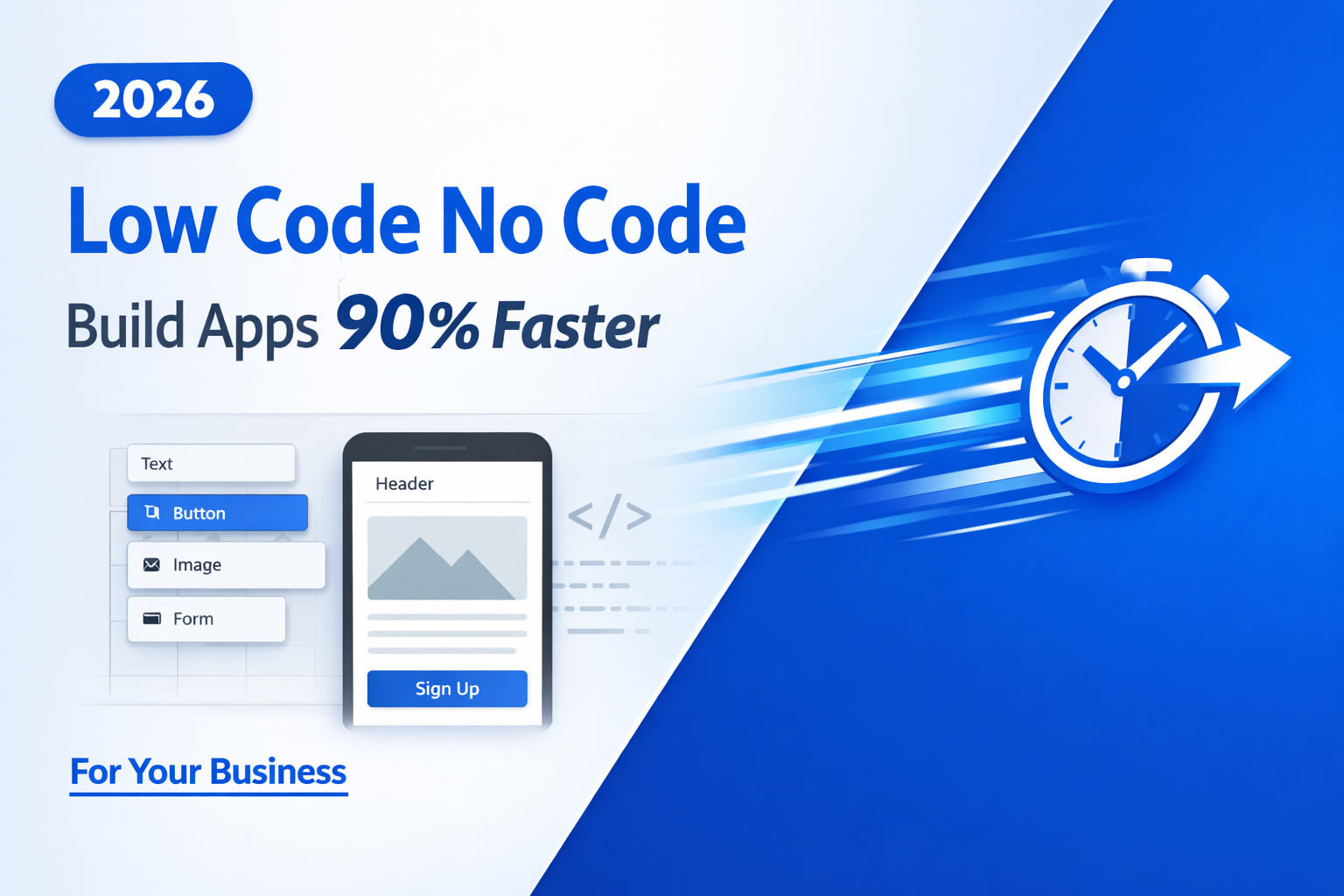
Low-Code/No-Code Platforms in 2026: How Citizen Developers Are Building Apps 90% Faster (And What It Means for Your Business)
Summary: By 2026, 75% of new application development will use low-code/no-code tools. Learn what this shift means for your business, which platforms are winning, and how to leverage citizen developers to accelerate product delivery.
The Developer Shortage Is Forcing a Reckoning
It's 2026. Your startup needs a new internal tool to manage customer onboarding. You call your VP of Engineering. "We need 3 months and $200K," she says. Your timeline is 2 weeks. Your budget is $10K.
Five years ago, you'd be stuck. Build it slow and expensive, or accept delayed execution.
Today? A business analyst with no coding experience builds it in a week using a low-code platform. Your engineering team reviews, tweaks, deploys. You're live.
This isn't hypothetical. This is 2026 reality.
The global software developer shortage is approaching 4 million unfilled positions. Companies can't hire engineers fast enough to build everything they need. The solution? Low-code and no-code platforms that empower non-technical teams to build applications themselves.
Gartner's prediction isn't optimistic—it's conservative. By 2026, low-code/no-code tools will dominate enterprise and startup development. The question isn't whether your organization will use them. The question is whether you're leveraging them effectively.
Low-Code vs No-Code: What's Actually the Difference?
No-Code: Literally zero coding required. Visual interfaces, drag-and-drop components, pre-built workflows. Anyone can use it. Business analysts, product managers, even non-technical founders can build functional applications.
Low-Code: Minimal coding. 80% visual, 20% code. Developers write custom logic when needed, but 80% of the app is assembled visually. Dramatically faster than traditional development.
The practical difference? No-code handles 70% of common use cases. Low-code handles 95%. For the remaining 5% that need custom logic, hire developers—but you only need them for the 5%, not the entire project.
Examples:
- No-Code: Zapier, Airtable, Softr, Bubble
- Low-Code: Microsoft Power Apps, OutSystems, Mendix, Appian
The lines are blurring. Bubble now supports serious custom logic. Power Apps added AI features. The platforms are converging toward hybrid models.
Why 75% by 2026? The Math
1. Economics
A senior developer costs $150K–$300K annually. A low-code platform costs $500–$5K monthly. A business analyst trained on the platform earns $60K–$100K. The ROI calculation is obvious: shift work from expensive developers to trained business analysts using platforms.
2. Time-to-Market
Traditional development: 6 months to ship a CRM module. Low-code development: 2-3 weeks. This 10-15x speed advantage is irreplaceable in competitive markets.
3. Maintenance Burden
Custom-built apps require ongoing maintenance, bug fixes, and security patches. No-code apps get automatic updates. Your IT team spends less time firefighting.
4. Citizen Developer Movement
Non-technical employees are sick of waiting for IT. They want to build. Platforms like Airtable and Zapier democratized app building. A business analyst can now ship a full application without touching code.
5. AI Integration
By 2026, low-code platforms integrated AI code generation. Power Apps can now generate forms and workflows from natural language prompts. You describe what you want; the platform builds it. This removes the final skill barrier.
The Platforms Dominating 2026
Enterprise Leaders
Microsoft Power Apps — Tightly integrated with Office 365, Azure, and Dynamics. Dominates enterprise. Built-in AI through Copilot.
Salesforce low-code tools (Flow Builder, AppBuilder) — Purpose-built for CRM workflows and enterprise automation.
OutSystems — Deep technical capabilities, beloved by enterprise architects.
Startup/SMB Favorites
Airtable — Database meets spreadsheet meets application. Ridiculously intuitive. 500K+ businesses use it.
Bubble — Visual web app builder. You can build Airbnb-level complexity without code.
Zapier — Workflow automation connecting 7,000+ apps. The glue holding modern workflows together.
Softr — Turn data into web apps instantly.
Webflow — Visual web design and development. Designers and non-developers build responsive sites without touching HTML/CSS.
Real-World Impact: How Companies Are Using Low-Code in 2026
Use Case 1: Internal Tools at Light Speed
Startup HR team needs an employee onboarding portal. Instead of a 6-month software project, they build it in Airtable + Zapier in 2 weeks. Cost: $500. Impact: 40 hours saved per quarter, perfect data collection.
Use Case 2: Customer-Facing Applications
SaaS company needs a customer portal. Instead of hiring 2 developers for 4 months ($100K+), a product manager builds it in Bubble in 3 weeks. Cost: $1,500/month platform fee. Customers get instant access. Revenue improves 15% from better user experience.
Use Case 3: Workflow Automation
E-commerce business needs to sync orders from Shopify to QuickBooks to Slack. Instead of building custom integrations, they use Zapier. 5 minutes to set up. Eliminates 10 hours/week of manual data entry. Cost: $50/month.
Use Case 4: Rapid Data Visualization
Finance team needs real-time dashboards. Instead of waiting for the BI team, they build it in Airtable or Power BI. Instant insights. Better decisions. No IT bottleneck.
The Developer Perspective: Opportunity, Not Threat
Smart developers aren't afraid of low-code platforms. They're leveraging them.
The shift: Developers used to spend 80% of their time on CRUD operations (Create, Read, Update, Delete). Low-code tools handle that. Developers now spend 80% of their time on high-value work: architecture, optimization, complex business logic, AI integration.
At WorldWebTree, our approach is hybrid: use low-code where it shines (internal tools, workflows, rapid prototyping), use code where it matters (complex algorithms, performance-critical systems, custom integrations).
This approach is the future. It's not low-code OR traditional development. It's both, strategically applied.
The Risks Nobody Talks About
1. Vendor Lock-In
Build your entire business on Bubble, and you're betting on their roadmap and pricing forever. Diversify. Use multiple platforms. Keep portability in mind.
2. Security and Compliance
Not all low-code platforms meet enterprise security standards (HIPAA, SOC 2, etc.). Vet carefully before using for regulated data.
3. Performance at Scale
Low-code tools work great at 1,000 users. At 1M users? Sometimes they struggle. Plan to migrate to custom code as you scale.
4. Skill Atrophy
If your team only uses low-code, they might lose core engineering skills. Balance tool adoption with skill building.
Your 2026 Low-Code Strategy
Phase 1: Identify Quick Wins (Week 1-2)
What internal tools take your team 10+ hours per week? What workflows are manual? Start there. Low-code ROI is clearest on time-saving internal apps.
Phase 2: Pick Your Platform (Week 3)
If you're enterprise: Power Apps or OutSystems.
If you're startup/SMB: Airtable, Bubble, or Zapier.
If you need web design: Webflow.
Phase 3: Train Your Team (Weeks 4-6)
Don't expect citizen developers to pick it up alone. Invest in training. 1-2 weeks of structured learning pays dividends.
Phase 4: Build Your First App (Weeks 7-12)
Start small. 1 internal tool. Measure impact. Learn. Then scale to more apps.
Expected ROI: 50-70% reduction in development time. 40-60% cost savings vs custom development.
The Hybrid Future: Low-Code + Custom Code
The winning strategy in 2026 isn't pure low-code or pure code. It's hybrid.
Build 80% of your application in low-code. Use custom code for the remaining 20% that requires specialized logic or performance optimization. This balances speed with flexibility.
At WorldWebTree, we help startups and enterprises architect hybrid solutions. We identify which components belong in low-code platforms and which require traditional development. The result: 3-4x faster time-to-market with production-grade quality.
Ready to Accelerate Development with Low-Code?
WorldWebTree specializes in low-code architecture and citizen developer enablement. We help teams:
- Audit your current workflows and identify low-code opportunities
- Select the right platforms for your use cases
- Train business teams to build and maintain apps
- Architect hybrid solutions (low-code + custom code)
- Ensure security and compliance
- Scale as your business grows
We've helped 30+ startups and enterprises implement low-code strategies, saving thousands of engineering hours and millions in development costs.
Book a free consultation to discuss your low-code roadmap. We'll audit your current development process, identify your best opportunities, and give you a concrete action plan. No pressure, just honest strategy.
Or reach out directly if you're ready to accelerate.
About the Author
Umar FarooQ is the CEO & Business Specialist at WorldWebTree. With expertise in full-stack development, architecture, and digital transformation, Umar has architected low-code strategies for 30+ organizations across fintech, SaaS, and enterprise sectors. His approach balances rapid development with production-grade quality.
Connect with Umar: LinkedIn (Umar-444) | WorldWebTree