From Zero to $10K MRR: How Startups Build Profitable SaaS Products in 2026
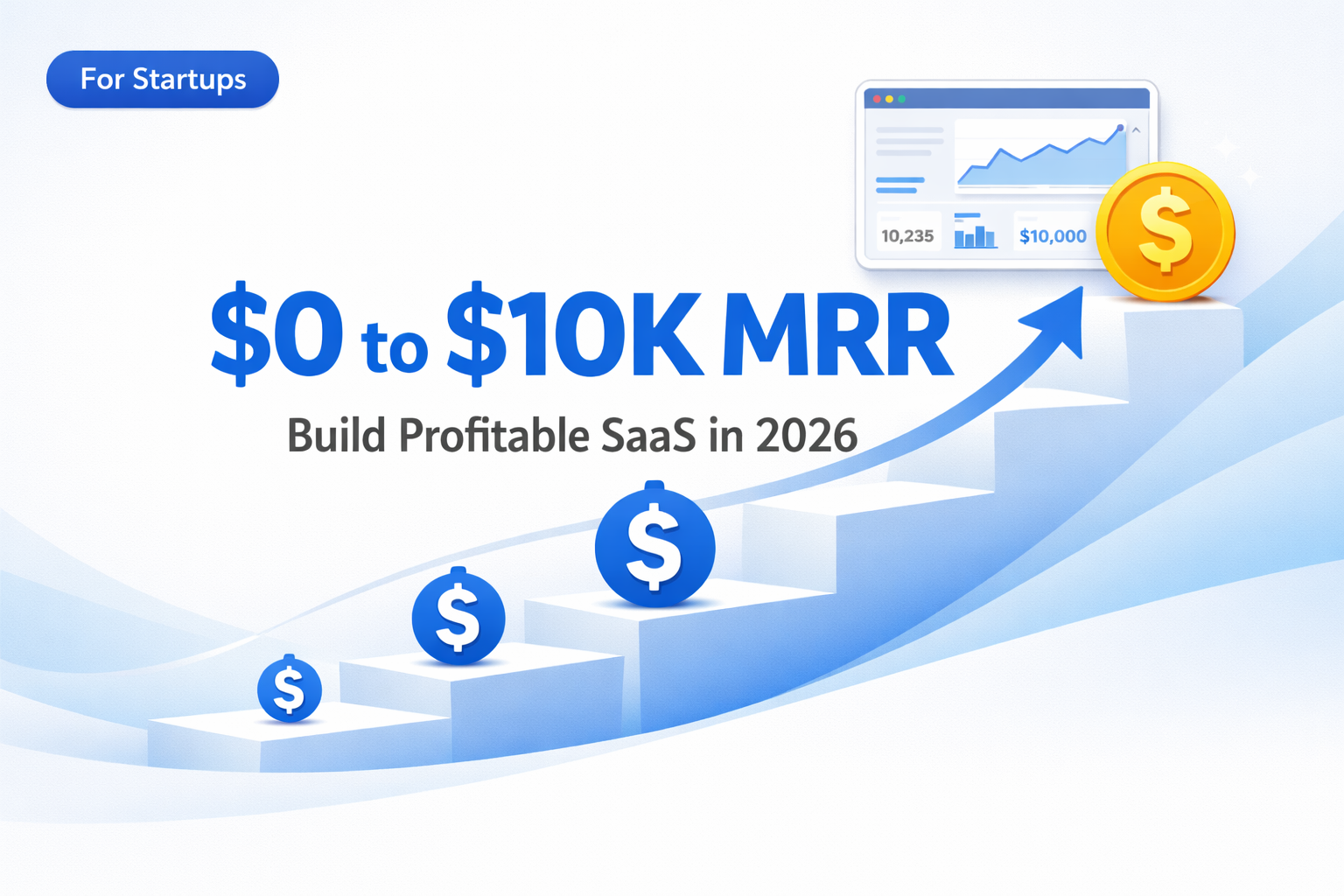
From Zero to $10K MRR: How Startups Build Profitable SaaS Products in 2026
Summary: Learn the proven playbook for building and scaling a SaaS product from idea to $10K monthly recurring revenue. Discover market validation strategies, MVP development shortcuts, and how to avoid the 90% SaaS failure rate.
The SaaS Opportunity for Bootstrapped Startups
You have an idea. A problem you've solved for yourself or your customers. Something that could become a business.
But you're looking at SaaS companies like Slack, Notion, and Figma—each raising hundreds of millions—and thinking: "That's not for bootstrapped founders like me."
Here's the truth that venture capitalists don't want you to know: SaaS is the most forgiving business model for bootstrapped startups.
Why? Because recurring revenue is predictable. A customer paying $99/month for 12 months gives you $1,188 in lifetime value. If you have 10 such customers, you've hit $1K MRR. At 100 customers, you're at $10K MRR—the magic number where a solo founder can pay themselves a respectable salary.
Unlike product sales (one-time transaction) or services (time-bound, doesn't scale), SaaS lets you build once and sell infinitely. Your first customer costs 10x more to acquire than your tenth. By customer 50, your acquisition cost drops to a fraction.
In 2026, bootstrapped SaaS founders are outcompeting VC-backed startups because they're lean, focused, and shipping products customers actually want.
The Brutal Truth: 90% of SaaS Startups Fail (And Why)
Before you start, understand the graveyard:
- Building without validation: Founder spends 6 months building, launches to silence. Zero customers. No one wanted it.
- Wrong problem: Solving a problem only you care about, not a widespread market pain.
- Poor positioning: Product exists, but nobody understands what it does or why they need it.
- Wrong customers: Going after enterprises when you should target SMBs, or vice versa.
- Giving up too early: Expecting 100 customers by month 3. Reality: 3-6 months to first customer.
The founders who succeed don't build in isolation. They validate obsessively, ship fast, and iterate based on real customer feedback.
The SaaS Startup Playbook: From Idea to $10K MRR
Phase 1: Validate the Problem (Weeks 1-4)
Your idea isn't special. Someone else probably had it. What matters is whether people will pay to solve this problem.
Your mission: Talk to 20 potential customers.
- Post on Indie Hackers, Hacker News, Reddit communities where your customers hang out
- Ask: "What's your biggest pain point?" (Not: "Would you use my product?")
- Listen. Take notes. Look for patterns
- If 15+ people describe a similar problem unprompted, you've got something
Success metric: At least 5 people say they'd pay money to solve this problem.
Phase 2: Build the MVP—Fast (Weeks 5-12)
An MVP isn't a product. It's a hypothesis with wheels.
Your MVP should:
- Solve ONE core problem brilliantly
- Take 4-8 weeks to build (not months)
- Be launched with less than 20 features
- Have a way to collect payment (even if you're not charging initially)
Technology choices matter: Pick the fastest path to market. If you're building a web app, use Next.js or Ruby on Rails—frameworks built for rapid development. If you need mobile, consider Flutter or React Native for cross-platform speed.
Common mistake: Spending 3 months perfecting architecture for a product that might have zero customers. Build for feedback, not production. You can refactor later when you have paying customers.
This is where WorldWebTree helps many bootstrapped founders accelerate. Their full-stack development team has built dozens of SaaS MVPs in 6-8 weeks—clean code, scalable architecture, ready for customers from day one. If you need a technical co-founder without the equity dilution, book a consultation.
Phase 3: Launch & Iterate (Weeks 13-16)
Don't wait for perfection. Launch when you're embarrassed by how unfinished it feels.
Launch channels for SaaS startups:
- Product Hunt — Get 50-200 users in one day
- Indie Hackers — Community that gets it
- Hacker News — If it's technical, this is gold
- Reddit communities — Niche but engaged audiences
- Twitter/X — Build in public, share your journey
What to expect: 50-100 signups, maybe 5-10 paid customers. This is success.
Phase 4: Find Product-Market Fit (Months 4-12)
You have customers. Now listen obsessively.
- Weekly customer interviews: 30 minutes with 3-5 paying customers. Ask: "What's one thing we should improve?" Then shut up and listen
- Track usage: Which features do users actually use? (Spoiler: not the ones you spent weeks building)
- Churn analysis: Why do customers cancel? This is gold
- NPS surveys: "Would you recommend this?" Honest feedback
Iterate ruthlessly. Cut features nobody uses. Double down on what's working.
Phase 5: Scale to $10K MRR (Months 12-24)
You have 50-100 happy customers. Now optimize for growth.
Acquisition channels that work:
- Content marketing: Blog posts solving customer problems (like this one). Rank on Google. Free, infinite traffic
- Paid ads: $100-500/month on Google Ads or Facebook. Track CAC vs LTV religiously
- Partnerships: Find complementary SaaS tools, negotiate affiliate deals
- Community: Hang out where your customers are. Reply to every question on Reddit/forums
Unit economics matter:
- Average customer lifetime value (LTV): $3,000+
- Customer acquisition cost (CAC): less than $300
- If CAC > LTV/3, your model is broken
At $99/month with 5-year average customer lifetime = $5,940 LTV. You can spend $500-1,000 acquiring customers and still be profitable.
Common Mistakes Early-Stage SaaS Founders Make
Mistake 1: Building for Everyone
A product for everyone is a product for no one. Pick a niche ruthlessly.
"Project management software for remote teams" beats "software for businesses." Narrow further: "Project management for freelance designers." Specific beats broad.
Mistake 2: Overengineering the MVP
You don't need a scalable database, microservices, or Kubernetes when you have zero customers. Start with simple. Upgrade when you hit bottlenecks.
Mistake 3: Not Talking to Customers
Building in a silo is how you waste 6 months. Customers reveal what you should build next. Listen.
Mistake 4: Pricing Too Low
Founders undervalue their work. If you're hesitating at your own price, it's probably too low. Charge more. Worst case: customers tell you; best case: you attract serious users.
Mistake 5: Burning Money on Everything
Expensive hosting, marketing funnels, premium tools—none of this matters at $10K MRR. Use cheap tools. Automate later. Bootstrap requires discipline.
Real Tools for SaaS Startups in 2026
Development: Vercel (hosting), PostgreSQL (database), Stripe (payments)
Analytics: Google Analytics (free), Mixpanel (user behavior)
Customer management: Intercom (chat + support), Zendesk (ticketing)
Email: Mailchimp (free tier is huge)
Project management: Notion (free), Asana (paid tier is $10/month)
Total cost to run a SaaS startup: $200-500/month. Not $5,000.
When to Seek Help: Bringing in a Technical Partner
You might be a brilliant marketer, designer, or domain expert—but building SaaS requires technical depth.
Three paths:
- Co-founder: Splits equity but brings full commitment
- Hired developer: Full-time hire, expensive ($5K-10K/month)
- Agency partner: Build MVP with WorldWebTree, then hire in-house
WorldWebTree specializes in helping bootstrapped SaaS founders accelerate from idea to launch. Their architects have built 50+ global growth products across finance, healthcare, and AI sectors. Contact them for a free technical assessment.
Your Path to $10K MRR
Here's the timeline:
- Month 1-2: Validate. Talk to customers. Confirm it's a real problem
- Month 3-5: Build MVP. Ship fast. Gather feedback
- Month 6-12: Iterate. Find product-market fit. Get to 50+ paying customers
- Month 13-24: Scale acquisition. Hit $10K MRR
This is possible as a solo founder or a small team. Thousands of SaaS businesses have followed this path.
The difference between you and the founders who succeed isn't intelligence or capital—it's action. They talk to customers. They ship. They iterate. They don't quit.
Your turn. What problem are you solving?
Ready to Build Your SaaS Product?
WorldWebTree helps startup founders build and scale SaaS products. Whether you need a technical co-founder, full MVP development, or architectural guidance, our team has helped bootstrapped founders ship products in 6-8 weeks.
Our approach: Architecture First, Design-Driven, Customer-Focused. We've worked with fintech, healthcare, and AI startups across the USA, UAE, and Europe—building scalable products that hit market fast.
What we guarantee: 100% IP Ownership • Weekly Demo Calls • 30-Day QA Support • Strict NDA Security
Book a free consultation to discuss your SaaS idea. We'll give you honest feedback, a technical roadmap, and an estimate. No pressure, no fluff.
Or reach out directly if you want to chat about your product vision.
About the Author
Umar FarooQ is the CEO & Business Specialist at WorldWebTree. With expertise in full-stack development, agile project management, and SaaS architecture, Umar has helped 50+ startup founders validate ideas, build MVPs, and scale to profitability. His insights on bootstrapping, product development, and business growth inform WorldWebTree's approach to helping founders succeed.
Connect with Umar: LinkedIn (Umar-444) | WorldWebTree